Problems get multiplied if they are not detected at the earliest.
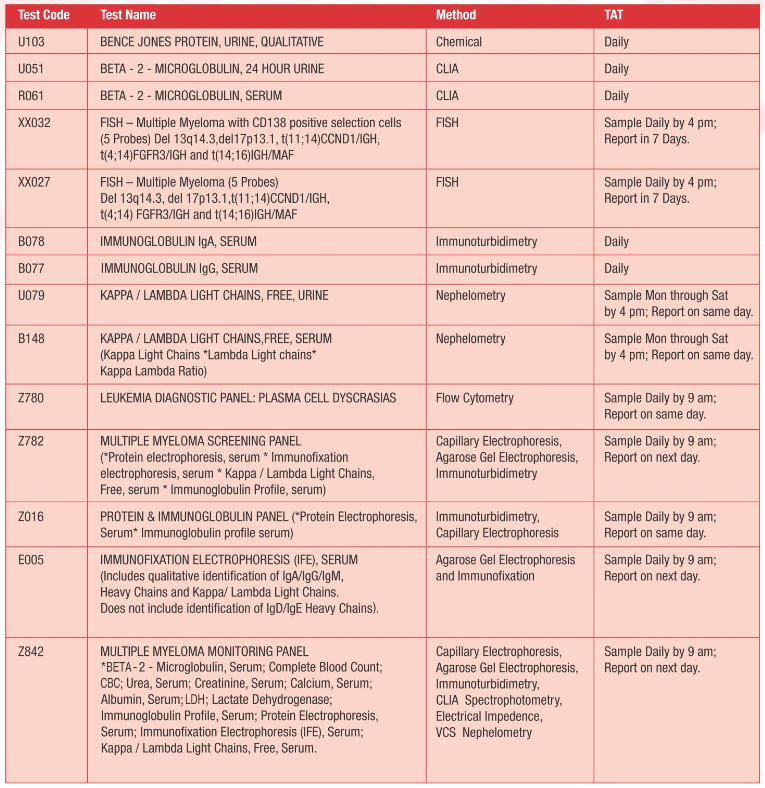
Dr Lal PathLabs offers end-to-end solutions by providing a comprehensive range of Multiple Myeloma tests.
NICE 2016, GUIDELINES ON MULTIPLE MYELOMA
While performing a bone marrow aspirate and trephine biopsy to provide prognostic information:
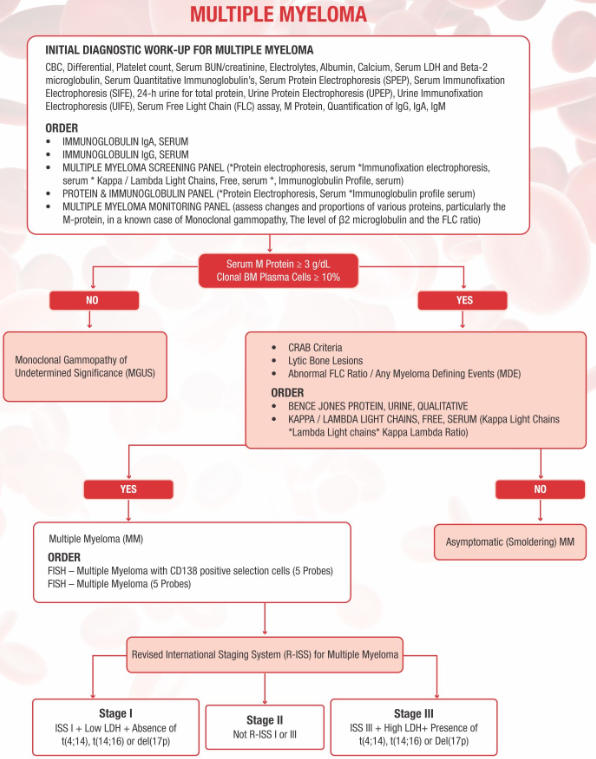
• Fluorescence In-situ Hybridization (FISH) on CD138-selected bone marrow plasma cells to identify the adverse risk abnormalities t(4;14), t(14;16), 1q gain, del(1p) and del(17p) (TP53 deletion). Use these abnormalities alongside International Staging System (ISS) scores to identify people with high-risk myeloma.
• Consider FISH on CD138-selected bone marrow plasma cells to identify the adverse risk abnormality t (14; 20), the standard risk abnormalities t (11; 14) and hyperdiploidy.
• Consider immunophenotyping of bone marrow to identify plasma cell phenotype and to inform subsequent monitoring.
• Consider immunohistochemistry (including Ki-67 staining and p53 expression) on the trephine biopsy to identify plasma cell phenotype and give an indication of cell proliferation to provide further prognostic information.
• Perform serum-free light-chain assay and use serum-free light-chain ratio to assess prognosis.
KEY INVESTIGATIONS
“Myeloma Defining Events (MDE) : Calcium >0.25 mmol/L (>1 mg/dL) higher than the upper limit of normal or >2.75 mmol/L (>11 mg/dL)
• Renal insufficiency (creatinine >2 mg/dL) (>177 prno1/14 or creatinine clearance <40 mUmin
• Anemia (hemoglobin <10 g/dL or hemoglobin >2 g/dL below the lower limit of normal)
• One or more osteolytic bone lesions on skeletal radiography, CT or PET/CT
• Clonal bone marrow plasma cells >6096
• Abnormal serum FLC ratio >100 (involved kappa) or s0.01(involved lambda)
• >1 focal lesions on MRI studies >5mm
REFERENCES
1. Sonneveld, P. et al. Treatment of multiple myeloma with high-risk cytogenetics: a consensus of the International Myeloma Working Group. Blood 127, 2955-2962 (2016).
2. Ghobrial, I. M. & Landgren, 0. How I treat smoldering multiple myeloma. Blood 124, 3380-3388 (2014).
3. Moreau, P. et al. Multiple myeloma: ESMO Clinical Practice Guidelines for diagnosis, treatment and follow-up. Ann Oncol 24, vi133—vi137 (2013).
4. Pratt, G. & Morris, T. c. Review of the NICE guidelines for multiple myeloma. Int. Jnl. Lab. Hem. 39, 3-13 (2017).
5. Risk Stratification for Multiple Myeloma. ASCO Annual Meeting (2016). Available at: https://am.asco.org/daily-news/risk-stratification-multiple-myeloma (Accessed: 27th March 2017).
6. Version 3.2017, 11/28/16 © National Comprehensive Cancer Network, Inc. 2016.